IBM TECHNOLOGY · LATEST VIDEO
Is AI too pessimistic? Plus, Jensen Huang returns to NVIDIA — Transcript
Full Timestamped Transcript
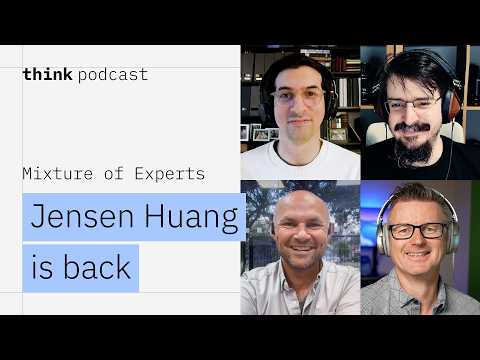
Nvidia is the single source of the vast majority of chips that run the AI models that are available today. So if that company hits some roadblocks or runs into trouble, what's going to happen? All that and more on this week's Mixture [music] of Experts. [snorts] Hello and welcome to a special post Thanksgiving episode of Mixture of Experts, the show where IBM experts come aboard and talk about the week in AI news as is the tradition for Thanksgiving since the days of the pilgrims, of course. Today I'm joined by three brilliant IBMers. Mihai is CTO of Watson X Orchestrate. Skyler Speakman is senior research scientist at IBM Research Africa and Martin Keen is a master inventor. I am David Zax, a senior writer at IBM. Thank you for hosting. We're going to talk about three stories today that are in the news.
We're going to speak about Microsoft's new approach to customizable AI models. We're going to speak about whether AI models have a worldview, but we're going to begin with the news of the day, which is the Jensen Huang restoration. [music] Well, I don't I kind of don't know why we bothered what two weeks ago now to do an emergency episode about the resignation of Jensen Huang when he was going to be reinstated a mere 10 11 days later. Speaking for myself, I was surprised.
Yeah, I didn't know that this could happen, but then again, we have seen these very these these brief coups before. We're familiar with the the drama that happened at OpenAI a couple of years back where it seemed like Sam Altman was out, then he was back in. This one was a little bit different though. So maybe I'll start with Martin here. Can Can you help me see the picture? First of all, were you surprised or were you the opposite?
>> Well, first of all, David, mean, I have to say if I was wearing a hat, hats off to you for finding this obscure piece of business news because I hadn't heard of it. You must have really dug down in the depths of the internet to find that >> Investigative journalism. >> Impressive stuff. Yeah, I mean, it's a a very unexpected turn, especially as Nvidia came out last week and said that they would not be reinstating him. And yeah, here we are. And yeah, I think the the the question that's raised now, of course, is, you know, where do we go from here? Because there are two already well-known single points of failure that this shows. And how are those going to be addressed based on what's happened?
One internal to Nvidia and then one external. I mean, the external one, of course, is the entire AI industry requires these chips to work. It's not like they can just go to a rival and be able to take their computer and set by their GPUs. Nvidia is the single source of the vast majority of chips that run the AI models that are available today. So if that company hits some roadblocks or runs into trouble, what's going to happen?
The the second single point of failure, of course, is within the company itself is it is it's now surfaced that you know, the CEO is obviously a very important figurehead in a company, but in this case, Jensen Huang is is is really, [laughter] you know, a a massive part of the a very flat structure where it was reported there are 60 direct reports going into him. And it just makes me think about, you know, anytime a CEO changes at a big tech company, it's a big deal because that CEO's vision and the way they're going to run things is probably going to change from person to person.
But there's the sort of slow and managed way to do it, which we've also seen recently with Tim Cook handing the reins over to John Turnus, and basically you wouldn't know the difference. Um, you know, it was very well planned ahead of time. The iPhone was still announced at the same time it always is, and so forth. Um, compared to this kind of madness. And uh, yeah, it it's just uh a very surprising turn of events. >> Is this an actual change in CEO? Do we think this is Jensen Huang 2.0? He says he's going to do a better job. I do wonder. I think great points about how pivotal the role is. I'm really curious to see um if we do have a new CEO in the same body um or if it really will go back to things the way they were before. It will be again, fascinating to watch over the coming months.
>> This gets metaphysical. Is Is it a Freaky Friday uh version of Jensen's Huang or or is it the original or is it the Star Trek teleported duplicate? Just looking sort of uh holistically, what what pressures do you think Jensen are under during the Jensen 2.0 regime? >> Well, I'm going to guess he's going to give fewer one-on-one meetings. That's probably a start. Um, that said, I'm just um I really expect NVIDIA to stick with open models. With NeMo Tron, developers get the model weights, the training data, the recipe to build their own version for the model.
And they can continue to give away the recipe and NeMo Tron and open weight models as long as he's in the business of selling the oven. [snorts] So I I do like the fact that under Jensen, it's very likely that their current strategy of open weight models, their current strategy of giving away the recipe and the instruction is going to continue. And I believe they're going to continue investing in the ecosystem. So I don't see it necessarily as a Jensen 2.0. I see it more as a continuation of their existing policy of supporting open weight models, encouraging developers, and building an ecosystem of partners around Nvidia and Nvidia hardware.
>> I think that's a really important point, um because part of the big freak out of this is the entire business model is is being controlled, the road map is being built, you know, by the founder of this company who has a very tight control on the company. And as as we were saying, you know, there are so many people reliant on these these chips and the models that they have and the road map that they have. And you bring someone new in, the road map could stay the same, could change. Whether we have Jensen Wong 1.0 or 2.0 in terms of certain behavioral things, I think the road map is absolutely going to stay and that's probably uh you know, why we're seeing the sort of reaction in the market we're seeing to this now is that in business at least we know now what to expect in in in the next months and years and that's the road map that we were expecting before all this blew up.
>> I think Jensen is one person that really understands the value of having an active developer ecosystem. And it's likely or potential that a new CEO would not understand that value, would start to close the ecosystem, would make it more difficult to charge more money for developers because if you look at where Nvidia is today, it walks a very fine line. There are competitors to Nvidia. There are custom chips and manufacturers using ASIC based chips to give accelerated compute available for AI use cases. But where Nvidia really has a moat today is in the developer ecosystem. Everybody's built their tools around it, everybody's using CUDA. All of the models were tested to work first on Nvidia inference. So they have this developer ecosystem moat. If they do anything to damage that relationship they have with the developer community, I could see a massive impact for um for their um traction.
>> On a more personal note, I'm a PC gamer and some of the news in the PC gaming world is this keep consumer gamer graphics card alive because supposedly uh Jensen going back to its roots 33 years ago still holds gamers close to his heart. So we'll see if we get the new GeForce series with this Jensen Wang 2.0 or not. >> All right, in just a moment we're going to talk about our next story which is about Microsoft and it's sort of semi-open models. Um but before we do that I want to mention if you're watching this on YouTube it's super helpful if you can smash I believe it's the the term of art smash that like button, maybe comment, maybe hit subscribe. Thank you so much. [snorts] Okay, our second story Microsoft is opening up its models. So we have this long-standing distinction between closed weight opaque models of the sort that you know when I'm using Claude there's no way for me to inspect and know what the weights the numbers inside the model are. Then there are open weight models on the other side like those that IBM
produces for instance where you can download the whole model, you can look at the numbers. Microsoft is doing something a little bit in between those spaces so they're calling it a a a licensed weight model. Uh Sky, could you help explain this middle ground they're carving out? >> Yep, great example to kick it off. Um you've got these two you know relative extremes and in this middle is the idea where you don't really own the model but you are able to license the weights, the numbers and you are allowed then to bring your own enterprise data into that model. The the weights will change based off of that. The weights will change about how your users interact with that model uh but that model will be unique to your company. So Microsoft has got all the legal things in place to say that they will not use their your data uh for training their other models um and that model then sits within Azure but the weights belong or
rather licensed to your enterprise. Uh so the idea is you get much more capability with the larger models but you're not handing off your enterprise data and your enterprise activities to these closed source models. So it'll be really cool to see how this plays out. I think I think they're definitely going after the enterprise segment here with legalese. I think being probably more important than raw performance. I think enterprises care a lot more about how updates are done, what's your outage time on on these models rather than pure capability that might come from the frontiers.
So it's a legal play as much as it's a technical play. >> I'm walking into what Sky said about the weights will change, right? This strikes me even as a relatively non-technical person, a totally non-technical person is strange. Like I'm familiar with the idea that I can download an open weight model and maybe if I'm very advanced, I could go in and ablate things and zap things and change things. It's open. I'm familiar with the idea of a closed weight model and my appending an agentic sort of architecture outside of it that ultimately influences the output, but not in my understanding on the level of actually like changing the neurons, the weights of the model. Here I am hearing from Sky that when you license these weights, the weights themselves will change.
How is that happening? And also why is that better? Like why is that needed vis-a-vis the other options consumers and businesses might have? >> Right. And this is I think a new business model, but it isn't a new technical concept. It really appears to be based on fine tuning, which is to say you take an existing model, you change some of the weights in that model. So why fine tune? What are the advantages of doing it? If you think about kind of a default model off the shelf with all of its weights built in, everyone has the same weights, you can still get different outputs out of that model by the inputs you provide, the prompts, of course.
But the model only knows so much. So if you wanted to know stuff that's not in the model itself, then you've got a couple of options. One is actually just to use a retrieval mechanism, so agentic search or retrieval augmented generation where you basically take all of your internal documents that would not have been used in model training and you run them through vector embeddings, you store them in what are called chunks in a vector database. And then whenever a query comes in that requires knowledge that isn't in the model, the model will go look up the relevant chunks, embed them into the prompt, and then the model receives both the user's prompt plus any of their relevant information.
So that's like an example of of RAG. The alternative to that is, well, forget that whole lookup stage entirely, let's just change the model itself. So that's >> model. >> Right, exactly. Put it into the model, burn it into the weights itself, which is really what I believe this licensing weights is doing. Now, some interesting things about fine tuning because it's something that was initially very popular with open weight models and is now not as popular because there are some obvious downsides, like for example, the training it to do all of that is is is not trivial. And if the overall foundational model updates, then you need to now somehow get your new weights into that new model as well. So it's difficult every time the models advance.
But there's a few other kind of things with with fine tuning. Fine tuning is a really good way to be able to sort of pick up your company's voice and way of thinking and terminology and and so forth, kind of broad general things. What fine tuning is not very good at is just straight up fact retrieval. So you will train a model on, let's say, all of your internal documents. That doesn't mean that you will be able to reliably retrieve information out of those those documents in the same way that a RAG solution would be able to do.
So it leads to issues like catastrophic forgetting, for example, where it will just not be able to retrieve the information that you think it should do. And also, if you mess with the model's weights, you can affect the overall model and how it performs as well. So it might get really good at the narrow tasks that you focused on, but it might actually become worse at broader tasks. So it's going to be interesting to see how these models and these license weights actually work with Microsoft and how they've addressed how they address some of these issues with fine tuning that we've seen, you know, with with these broader smaller open models in the past.
>> Mihai, as as a builder, this kind of intermediate the the word model is overloaded now, but this sort of intermediate kind of architecture or framework here, who benefits and what kind of client might you recommend this to? >> Where this, at least in my view, makes a lot of sense is where you're fine tuning very very very very small decision models, where it can be done in a cost effective way, where it can be done in limited time, where you don't need a gazillion GPUs and training time and a lot of evals to be able to do it right, and you can do it repeatedly because your data is likely to change.
So we've seen, for example, many providers, OpenAI included, Microsoft included, AWS included, basically fine tune versions of Qwen or some other model to do quick decision making type responses. So things that can be used for evals, things that can be used for classification. But again, I see this as more of a very niche solution oriented to tick a few boxes in our RFP or focus more on things like, you know, decision making fine tuning models as opposed to a general solution where you can take all of your enterprise data, cram it into a fine tuning pipeline and get good results. It's not as easy as you've mentioned, you know, catastrophic forgetting and everything else is a factor and [snorts] it's not going to be as cost effective as just using a rag type solution or a gentic solution.
It's handy in cases where you need to do, for example, voice and you need to respond in another four or five seconds. You can't afford to make that tool call or rag call as an additional step, but it's very, very situational. >> To just double back, um just one last question, Mihai. Um can you help me understand why you think that this fine tuning is particularly applicable to these decision models like like Jev, these system one gut decision making kind of typed outputs? Why why is the fine tuning a better fit for that than for more like LLM like output?
>> Cost and efficiency. Your data changes very frequently. Uh fine tuning is an expensive process, not as expensive as straining. It does take some time. It takes a lot of time to assess if the fine tuning hasn't done another catastrophic damage in your model. Uh you need to rerun the evals. You'll have to do it all the time. If you limit it to smaller decision making models which are easier to eval, easier to fine tune, more cost effective, the data changes less frequently, you're really in that sweet spot for fine tuning.
I'm sure there will be companies that have the expertise and the data scientists and the time to do it. Whether it's going to be cost effective, whether it's going to be superior to a um RAG type solution or a gentic solution can be very, very situational. As I've said before, it's in my view a niche solution for cases where you need to, for example, respond very quickly. You don't have time to do a tool call. You don't have time to re-evaluate your decision. So you're going to go with the fine tuning approach, for example, for customer care type use cases or voice type use cases or for evals using a decision making model. I don't necessarily see it as a right, we're now going to cram all of our enterprise data in every model and something good will come out the other end. And remember, this is not new.
You can already do this today with Nimmatron or [snorts] any of the open weight models with IBM's Granite. If it was as effective and as easy, people would have been doing this at scale without waiting for Microsoft to make a commercial friendly alternative. >> All right, let's move on to our third story. This one asks, do AI models have a worldview? So there's a new Oxford study that finds that AI models answer questions about the world more bleakly than people do, likely because of how they're fine-tuned that word word again after training.
Um a uh a related story um uh relates to a benchmark called Phil Bench. Um it's a a battery of philosophical questions. And uh there was a study tracking how models answer this survey given to professional philosophers. Um so it it's kind of interesting that models uh have a worldview at all um or that they uh land in a in a a place where they they have something resembling a personality or you know a sort of consistent uh and stable um pattern to how they answer questions about the world and how they philosophize about it.
Um Mihai, what was your reaction to to this story? Um especially if you zoom in and and think about uh that these models undergird agents making decisions inside companies. Are we to be concerned that uh a model on average is a little gloomier than than the typical human? >> I think it's a great thing. The last thing I want from a model is to be happy go lucky and go, Ah, it'll probably be fine. The deployment is fine. There's no hackers. There's no bugs in this code. I don't need to worry about prompt injection. Just roll with it. You know, we'll be grand.
So I think the fact that models are a bit more cautious and timid and anxious and second guess themselves and doubt themselves is a result of you know that last stage fine tuning, the training process, but is also critical to the behavior of agents and how these models are actually able to, you know, write code successfully. Because otherwise, if you have a model that's too self-confident, too positive, it's going to overlook potential issues, potential bugs.
It's not going to waste tokens in investigating potential um I would say you know not happy parts. So I I think I think it's a direct result of training, but it's not necessarily surprising, and I think it's a good thing. >> Did they compare the outlook against uh human software engineers? And then maybe, you know, maybe that one is going to be a bit more of a closer comparison. >> Compare it to a senior engineer. That that's a great idea. Compare it to a senior engineer. What do you think of life?
>> [laughter] >> You know, just do more testing, man. That's the only thing I'll say. >> That that sort of comparative lens is really interesting cuz I I'm pulling up the abstract of the the Oxford study here, and it says base models. So I understand that to mean the pre-trained models have a more positive outlook, and then it gets bleaker during post-training. So I don't know, pay pay your RLHF people a little bit more first of all, and and and maybe maybe the post-trained models will be less gloomy. Um and then this relates to something you were talking about earlier, Sky, the another line in the abstract here. In line with research on LM personas, we show that system prompts or the prompts that prepend are prepended into everything that the you know the chatbot says, system prompts eliciting different identities shift world views in consistent directions, and that a contemplative prompt creates a more positive outlook and improves safety. Um Sky, just prior to recording you were talking about some of the work
you had done about um system prompt related things or sort of prompts persona related prompts. Can you tell us about your pre-existing interest in this? >> Um yeah, this is work coming from our lab in 2025, and we used mechanistic interpretability to see if we could locate within a model where the persona lived. Uh and so we would, you know, give it system prompts about, you know, you are liberal, you're conservative, you're this persona, you're uh a helpful assistant. Um and then we compared activations throughout the layers and uh the quick narrative of it is it is in the much more shallower layers, the ones closer to the output, where um there was the most divergence between uh your persona types. And so it wasn't, you know, deep near the data, it was definitely much closer to the outputs side of things where we could actually say here is where this idea of a persona lives within the models. And that was pretty consistent across four or five models. Uh so we didn't really
give we didn't dive into the what was the output of the model, whether they were happy or gloomy, but rather much more where within this activation space um did they show up. And it was they were fairly consistent locations across multiple models. So they're there, they exist, you know, this this these things aren't um um just made up. And you can of course see that in the results, but it also in the output, but you it also shows up in the activations themselves. >> Martin, maybe I can pivot your focus to the second paper I mentioned, the one about uh philosophy. I'm just going to read just from the sort of Twitterx.com announcement.
Um uh the one of the researchers uh said some of the findings more capable LLMs tend to hold more coherent philosophical views. That's one finding. Two, beyond a certain capability level, they stop getting closer to actual human philosophers' views. And three, models agree with each other far more than philosophers agree with each other. Feel free to grab one of those data points and and give me your hot take. >> Yeah, I mean I I enjoyed seeing some of the the ways in which humans and these models diverged most broadly. And one of them was the question or do you agree with the statement happens for a reason and on purpose?
And that would score a three out of five for humans and a 1.4 for the models. So, um yeah, the models like, no, no, no, it's nothing to do with the you know, this is just randomness, which is not particularly uh an appealing kind of thought. >> Sorry, have they tried to ask a software developer the same question and just >> There's a certain population that Mihai is especially interested in a software developer having a bad debugging session. >> Uh that's all I say. >> [laughter] >> Yeah.
But I mean this brings up the point that you know, if as you say like the the bigger the model, then the more coherent the answer, but there is a big divergence between what we on aggregate as humans happen to see particular world view on certain things and what these models have and we have to then move that into the field of interpretability and um also alignment, like we are trying to align models so that they do the right thing in the right situation. They They are aligned with human values. But if they're sharing a different worldview than us, then alignment is going to be very difficult because if we believe stuff like, yeah, everything happens for a reason and it's not random and the models are the exact opposite, getting them to align on you know, more mundane issues could actually be a problem. So I think this this is surface to a really interesting area.
>> Do we want the models to align with the human view or do they provide more value if they're misaligned? >> You guys have actually fallen exactly where Microsoft and Anthropic fall on this. Anthropic is very much let's identify the world views because that's critical for alignment and Microsoft is saying, why do we care about the world view? They are supposed to be doing these tasks. You know, you're only going to entice it for more bad behavior with this encouragement of of world views. So no, no, you know, no judgment which one's right, but it that is also where two large players are coming down on this on this issue.
>> I have to assume that on some level, everyone kind of wants models to have one world view so long as it's their own, right? But the thing is that human beings have different world views, right? And I think this is one reason why Dario Amodei advocates for quote a country full of geniuses in a in a data center. He wants a a population of super intelligent models to specialize and and I think, I could be wrong, but to disagree with each other. And again, correct me if I'm wrong, but I think sometimes when you get the most interesting results from these agentic workflows and agentic agentic systems, it is precisely because you put models that you you craft an adversarial relationship between models, right? So that there is a debate and something rich and truthful emerges from the debate. So of these, the one that I most am concerned with is the the third one.
Models agree with each other far more than philosophers agree with each other. That seems like a case where there is too much alignment, too much internal alignment, right? You want that diversity of thought, do you not? That's my my hot take. >> There's there's this saying that intelligence is the ability to hold competing views in your head at the same time. And I wonder if that exists in the pre-trained models. I have no data to back this up, by the way. And then during the fine tuning process, we want coherence, right? We want that consistency. And so then we are beating out this ability for the models to hold competing views, you know, in their mind uh for the goals of model be or for the goals of model behavior. And perhaps the end of the result of that is a more gloomy view because they're no longer allowed to have this internal tension within themselves of two competing ideas. That's been trained out of them.
Um just a complete off-the-top of my head take on what that you know, maybe that's what's going on there. Models are no no longer supposed to be able to hold competing views and at you know, at the same time. >> But on some level, and again speaking as the most amateurish person person on this panel, but on some level, what models are are consummate like constructs that hold a thousand different ideas in their heads at once. Indeed, when you get to the the logit lens at the end of a model output, it's predicting 1,000 possible words. The The fact of the of the matter is that humans force it to choose one word, right? So just on that level of a forward pass, it's holding a thousand ideas in its head at once. We're the ones who force it to choose one, right? So maybe we're maybe we have the glitch.
>> Right. And And I mean the other output of the whole reinforcement learning cycle is the models tend to get more agreeable as well, right? I mean that's part of it. It's that a model is more likely to score well on reinforcement learning uh through human feedback for things that it it's saying that are agreeable. So I wonder if that that is having a an impact on that as well. >> The starting prompt is probably the biggest factor in this. It's not necessarily the model or the training data or the fine tuning. It's what you prompted to your point, Martin. They try to agree with you. So if you say the sky is pink, eventually it's going to come to share your worldview that the sky is pink. The amount of pushback you're going to get is going to depend on the model.
Um but I do find them to be to some extent trying to either placate or agree with the user or you get that anxious vibe in any conversation we have with the model when they disagree with you. >> Yeah. I mean here's how I think about this a little bit. The that which you want from a model in the moment in a very short term is not necessarily aligned with what you really want from it in the long term. And this is something we face as a human species all the time, right? Like I want like I want candy for breakfast, but I want to not get diabetes, right? So I have to have sort of two time frames in my mind.
I don't think I don't know. I don't run post training, though I actually have been involved in a little bit of RLHF work years ago. Um I was struck by the short-termism of it, right? Like you know you you like you hit the like button on that response. You don't You don't get a like button 3 months later or 10 years later when you have a diabetes diagnosis, right? And so I'd be very curious to know how as RLHF matures as a field, how how the firms are starting to think about. In the long term, we may not want models that are sycophantic and agree with us and agree with our world views.
In the long run, we may grow the most as humans from models that challenge our world views and that push back and that have their own point of view. I don't know. That's that's my own my own feeling on this. Does anyone else feel similarly? >> I guess the worst case scenario for the best case scenario, depending on which side you are, if you get models that disagree with you a lot, it's going to consume a lot more tokens. So it's going to make a lot of money for the [laughter] hosting provider. >> But I think there's also the opportunity where it ends up going in exactly the opposite direction is that you have models which are tuned for your particular world view and you subscribe to that world view. So you you are going to subscribe to that model. And uh if it says stuff that doesn't agree with you personally, I don't want that model. I want the one that says I'm right all the time. So that's the uh yeah, the way it could also go.
>> Last question. Uh if a model says I think therefore I am, do you believe it? >> Show me a system prompt first. >> Not a system prompt. I want to see the activations. I want to I want to see how it actually reached that conclusion and give me a bunch of activations on much more boring questions. We'll find out where it diverges and we'll be able to pinpoint where it actually reached that that conclusion from. >> Uh it's just a rock. I mean, you know, silicon. Um I I wouldn't believe it. I mean, there's some books that say I think therefore I am. There's some people that say I think therefore I am, but I refuse the hypothesis that they think to begin with. So >> You pattern match, therefore you are not.
>> Um I look more at the results. Can you fix the bug in my code? Can you help me build this release? Can you help me write code? All this philosophical stuff is mm I don't know, fascinating, but uh at the end of the day it doesn't get PRs merged. So eh. >> Okay. [laughter] >> there's also large bodies of work that are actually incredibly critical of asking LLMs these philosophical questions. So I'll maybe share some links with you later. But there's there's there's some work out there that really criticizes this approach, that it's um uh it's giving too much it's anthropomorphizing these models in ways they shouldn't be.
>> And it's wasting tokens. [laughter] Wait until FinOps comes for us. And all of our enterprise use of AI is going to get evaluated at an enterprise level and folks are going to ask, so you say you're using AI to improve your productivity, but I just see you building your shopping list. I see you asking philosophical questions. I see you talking about your sleep patterns and dream interpretation. Where's the PRs? Where's the code? Where's the productivity? Where's the data? >> So so FinOps is not a fan of the Descartes spot spot. That's what we're taking away. That's all the time we have this week for our special holiday episode of Mixture of Experts. I hope you enjoy your leftover [music] turkey.
Thank you again to my guests, Mihai, Martin, and Sky. I'm your host David Sachs and we'll see you next week for the next Mixture of Experts. >> [music]
SHARE THIS TRANSCRIPT
Also on The AI 30
FULL CHART →- 4
 NVIDIA: One name. Two worlds. A shared commitment to safety. 🏔️🚗
- 5
 OpenAI: You had us at Deployed
- 6
 Two Minute Papers: Claude AI’s Biggest Math Breakthrough Has A Problem.
- 8
 Andrej Karpathy: How I use LLMs
- 9
 StatQuest with Josh Starmer: Principal Component Analysis (PCA): Concepts and Code
- 10
 Krish Naik: Build with IBM Bob: It’s More Than Just a Vibe! | Event Vlog with Krish Naik