Yes. An AI can't sit through a video, but it can read the video's transcript, and for most YouTube videos that is where the content is: what was said, and when. On November 21, 2026 we had an AI "watch" 101 YouTube videos, 34 hours of them, by reading their transcripts. It took 3 minutes 28 seconds.
We used our own tool, YouTubeTranscript.dev, to get the transcripts, and an AI model to read them. Below is what went in, what came out, what the AI got wrong, and how to do it with your own list.
What did we feed it, and what did it cost?
The kind of list everyone has and never gets through: everything 29 AI YouTube channels posted in nine days. We took the 31 AI-tools channels from an earlier study and kept every upload of 3 minutes or more published from November 12 to 21, 2026. Two channels had posted nothing that long, which left 101 videos.
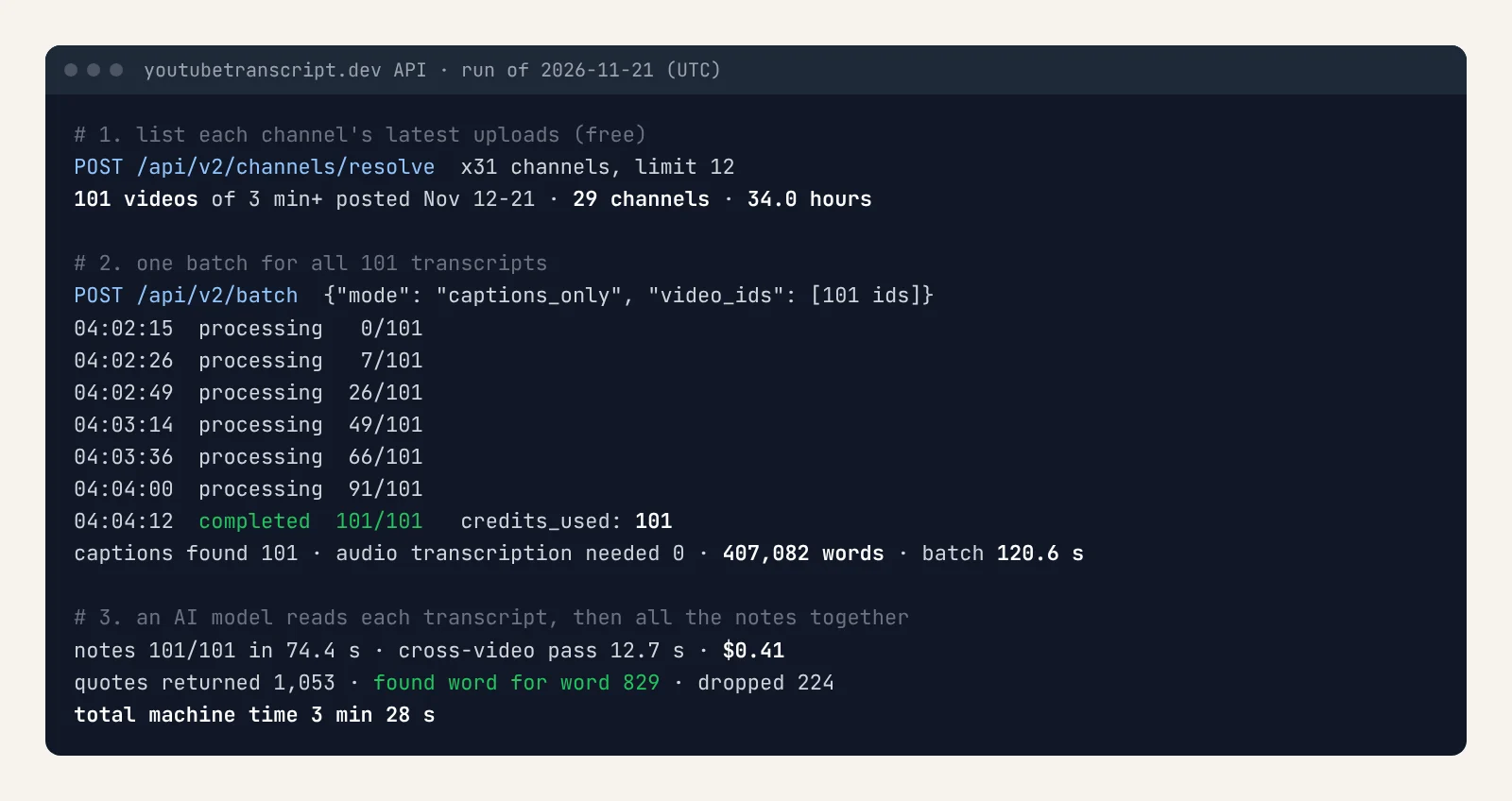 The real run, November 21, 2026 (UTC), through the YouTubeTranscript.dev API.
| What we measured | Result |
|---|---|
| Videos | 101, from 29 channels |
| Length | 34.0 hours (median 17 min 49 s, longest 56 min 55 s) |
| Transcripts found | 101 of 101 had captions; none needed AI transcription of the audio |
| Words | 407,082 |
| Time to get every transcript | 120.6 seconds, one batch request |
| Time for the AI to read them | 74.4 seconds (one pass per video) + 12.7 seconds (comparing them all) |
| YouTubeTranscript.dev credits | 101 (1 per video) |
| AI model usage | $0.41 |
How we measured: channel lists and the batch went through our API on November 21, 2026 between 04:00 and 04:05 UTC. The batch time is from the batch's own created and completed timestamps. Words are counted on the returned text. Credits are our balance before (2,189) and after (2,088). The AI cost is the tokens each request reported, at the model's list price.
What did the AI find that kept coming up?
We asked the AI for each video's lessons, each with a quote copied from the transcript. Then it grouped lessons that made the same point. The counts below are videos, worked out from those groups, not numbers the AI wrote.
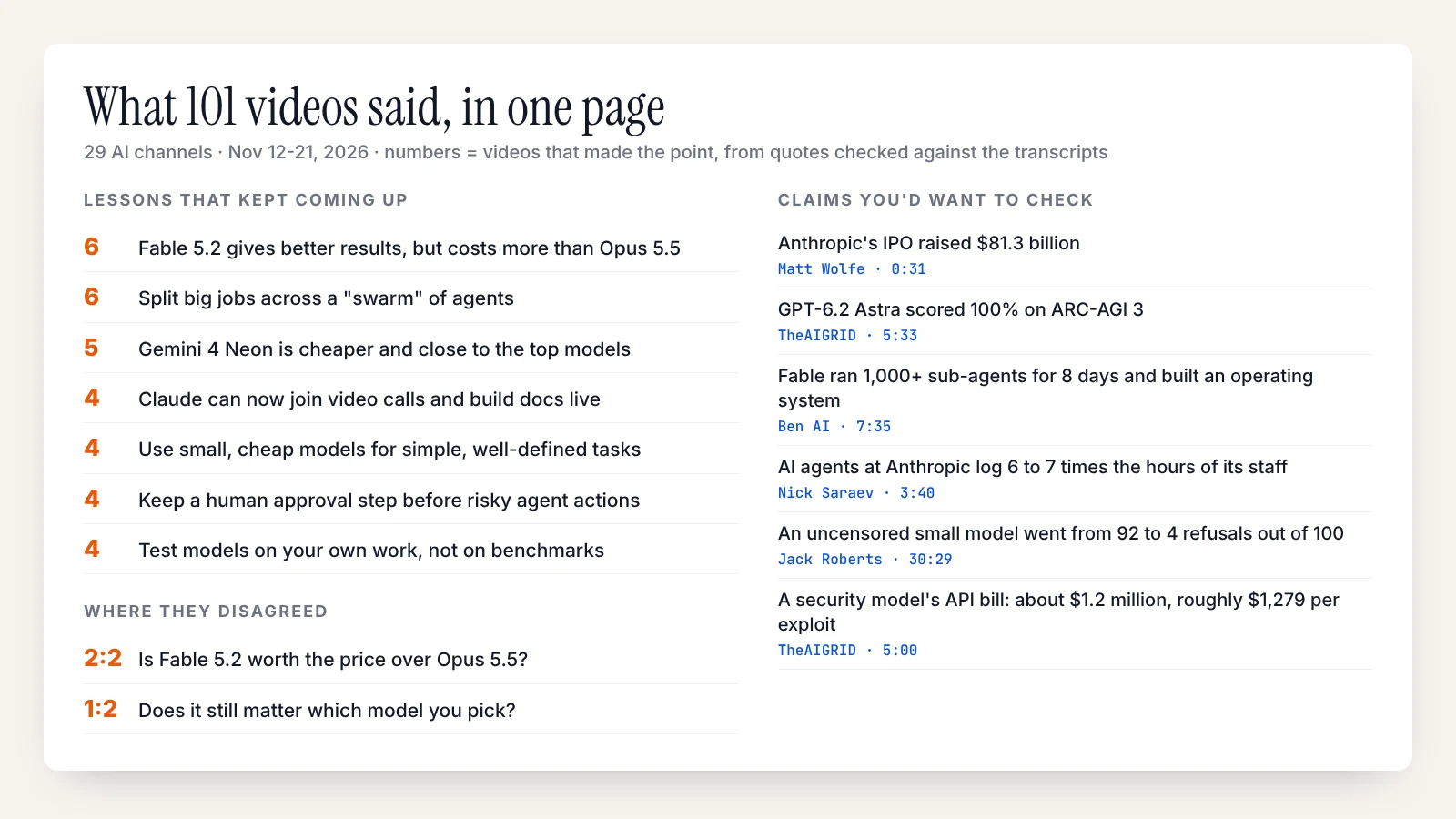 What came out: the one page we would have read instead of 34 hours.
- Fable 5.2 gives better results but costs more than Opus 5.5 (6 videos). Jack Roberts found it "twice as expensive as Opus 5.5 and 50% slower" (24:50).
- Split big jobs across a "swarm" of agents (6 videos).
- Gemini 4 Neon is cheaper and close to the top models (5 videos).
- Claude can now join your video calls and build docs and whiteboards while you talk (4 videos).
- Use small, cheap models for simple tasks (4 videos).
- Keep a human approval step before risky agent actions (4 videos).
- Test models on your own work, not on benchmarks (4 videos, 3 channels). "Make your own benchmark. Take five to 10 real tasks you do every single week" (TheAIGRID, 29:22).
A plain word count, with no AI involved, shows what the week was about: Claude came up in 78 of the 101 transcripts, Fable in 58, Opus in 56, GPT in 41, Gemini in 35.
What were the most surprising claims?
We asked for the claims that would surprise someone who follows AI. These are what the creators said, at the moment they said it. We did not check them, and you should before repeating them.
- Anthropic's IPO "raised $81.3 billion" (Matt Wolfe, 0:31).
- GPT-6.2 Astra "scored 100% on ARC-AGI 3", the first perfect score (TheAIGRID, 5:33).
- Fable "coordinated over a thousand sub agents working around the clock for eight days and built a working operating system" (Ben AI, 7:35).
- At Anthropic, AI agents' hours on tasks outnumber its people's "by six or 7 to one" (Nick Saraev, 3:40).
- A small open model "refused 92 out of 100" requests, and 4 out of 100 after its safety training was stripped (Jack Roberts, 30:29).
Where did the creators disagree?
This is the part a summary of one video can't give you. We asked the AI to find questions that different channels answered in opposite ways.
- Is Fable 5.2 worth the price? Two said yes: MattVidPro ("for some people it's definitely worth it", 8:16) and Jack Roberts, who uses it as his daily driver (26:03). Two said stick with Opus 5.5: Ben AI ("faster and it's half the price", 4:16) and David Ondrej (2:14).
- Does it still matter which model you pick? corbin: "at a certain point it's just going to get so good it doesn't matter who you choose" (3:21). AI Explained: try "the main three families of models on your particular task" (2:03).
- Is AI video editing good yet? Wes Roth called Fable "top of the line" (20:52); Nate Herk tried two top models and "they were both really bad" (9:12).
Did the AI get anything wrong?
Yes, and that's why every finding came with a quote.
- Made-up quotes. It returned 1,053 quotes. We searched for each one in the transcript: 829 were there word for word, and we dropped the other 224 (21%). Every timestamp in this post comes from the transcript, not from the AI.
- Disagreements that weren't. It flagged 7. Reading them, 4 held up. In one it put a creator on the wrong side, which we fixed.
- What's only on screen. A transcript has what was said. A chart, a demo or a code editor with no narration is invisible to it.
- Spelling in captions. One video's title says "Riemann Hypothesis", but the word appears in none of the 101 transcripts, because the captions spell it differently. Search by idea, not only by exact word.
How do I do this with my own list of videos?
On the website. Paste a channel or playlist link into YouTubeTranscript.dev and every video's transcript comes back in one job, with timestamps. Your Watch Later list is private, so copy the videos into a public playlist first. Then give the transcripts to the AI assistant you use with the prompt below.
Here are transcripts of videos I saved and never watched. For each video, give me up to 5 lessons I could use, and the most surprising claim. Quote the exact words from the transcript for every point, with its timestamp. Then, across all the videos: which lessons came up in 3 or more videos, and where did two videos disagree? Only use what is in the transcripts.
For more than a few videos, split them into groups, as in how to summarize long documents with AI.
With the API. This is what we did: list a channel's uploads, send every video ID in one batch request, then read the transcripts with any AI model. Ask for verbatim quotes and check each one against the transcript text before you trust it; it takes a few lines of code and caught 224 bad quotes for us.
In Claude Code or Claude Desktop. YouTubeTranscript.dev has an MCP server, so Claude can fetch transcripts itself. Add it with your API key:
claude mcp add --transport http youtubetranscript https://mcp.youtubetranscript.dev --header "x-api-token: YOUR_API_KEY"
Then ask: "Get the transcripts of these videos and tell me what I missed, with timestamps."
How much would it cost me?
- Transcripts: 1 credit per video with captions, whatever its length. Our 101 videos cost 101 credits. Videos with no captions are transcribed from the audio at 1 credit per 2 minutes.
- Plans: the free plan gives 10 credits a month and up to 10 videos per batch. Basic is $9 a month for 1,200 credits and up to 500 videos per batch, enough to run this 11 times a month. See pricing.
- The AI reading: $0.41 for 407,082 words in our run. A larger model would cost more; a small one did the per-video reading fine.
34 hours of video, read in under four minutes, for 101 credits and 41 cents. The catch is the one above: ask for quotes, and check them.
Frequently asked questions
Can AI actually watch a YouTube video?+
Not the way you do. It reads the video's transcript, which carries what was said, with timestamps. It misses what is only on screen, like a chart or a demo with no narration. For talking-head videos, tutorials and podcasts, the transcript holds most of the content.
How long does it take to summarize 100 YouTube videos with AI?+
In our run on November 21, 2026, 101 videos (34 hours) took 3 minutes 28 seconds of machine time: 2 minutes to get every transcript in one batch, 74 seconds for the AI to read each one, and 13 seconds to compare them all.
How much does it cost?+
Our run cost 101 credits on YouTubeTranscript.dev (1 credit per video with captions, whatever its length) and $0.41 of AI model usage. The free plan gives 10 credits a month; Basic is $9 a month for 1,200 credits and takes up to 500 videos per batch.
Can I trust the AI's summary?+
Check it. In our run the AI returned 1,053 quotes and only 829 were in the transcripts word for word; we dropped the rest. Of 7 disagreements it flagged, 4 held up. Ask for a quote and a timestamp with every finding so you can check it in seconds.
Can Claude watch my Watch Later list?+
Claude can read transcripts through YouTubeTranscript.dev's MCP server. Your Watch Later list is private, so add the videos to a public playlist, or give Claude the links, then ask it to fetch each transcript and summarize.