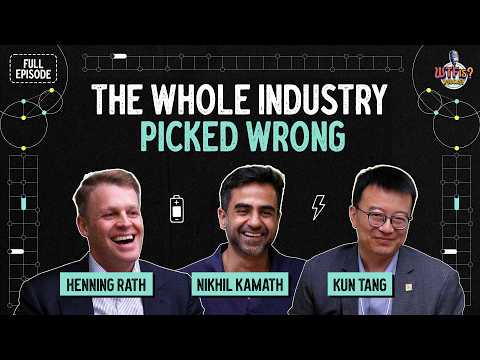
NIKHIL KAMATH · AUGUST 10, 2026
The Battery Everyone Uses Is The One They'd Never Build | EnerVenue x HiNa | WTF are Batteries? — Transcript
Full Timestamped Transcript
So I don't know much about batteries, I want you guys to teach me, you both are the experts. What is a cell? What is a battery? So what do you need in a sodium battery? Do lithium cells have a lot of rare earth? What about solid state batteries? One works on sodium battery, one was on the solid-state batteries, so I choose the sodium one.
I think sodium is amazing. I think it must be the future. Why does CATL have a monopoly on batteries then? I wouldn't call it a monopoly. I would say they're very competetive. Do you think there's an opportunity to start an electric car company today? I think, when it comes to electric car company and me being German, I probably have a different view on this. -You were wrong. -Absolutely. I hear of a Tesla catching fire once in a while, or a BYD catching fire-- Last year, 2025, the world had over 14,000 LFP fires.
-It is not once in a while. -Wow. Maybe it makes it to the news once in a while. That is correct.
Thank you both, Tang and Henning, for doing this. I'll tell you why I wanted to do this. It feels like the world is going through so much turmoil around energy. And I have a fund, a private equity fund, where we do invest in a lot of energy transition companies. Energy does not seem to be the problem as much as it is the fungibility, the movability, and the storage of energy today.
In India, where I come from, the cost of producing renewable power has gone down tremendously, but I think the problem, like in other countries, is we don't have the means of efficiently storing it and then using it when the requirement is. So I don't know much about batteries. I want you guys to teach me. You both are the experts. But before we begin, maybe you can give me a couple of minutes about yourself so our audience gets to know you. Would you like to go first?
Or you, either? I can start. Nikhil, thanks, first of all for inviting me. Much appreciated. Out of the beautiful city of Dalian, World Economic Forum just mentioned-- They luckily gave us the room. So I'm heading-- Originally heading from Germany, I'm a mechanical engineer and economist by trade. And I built my entire life, basically around infrastructure projects. I left Germany around, nearly 20 years ago, moved to Australia, worked for a mining company, then went to India, built a steel plant close to Kolkata, spent a lot of time in Indonesia, then came to China, studied in the US, and in the past 15 years, I've been working in China.
I was just asking him outside, how does it feel to be a white man in China? Good right? Good, of course. I feel very comfortable in China. My family lives here. My daughter goes to school. It is safe. The people are friendly. Food is amazing, so-- Is it still a rare occurrence, white people living in China? It depends a little bit where you are, right? So if you are in tier one cities, Beijing, Shanghai, Shenzhen, Guangzhou, I think a lot of foreigners are around and...
working here. So right now I'm building a factory in Changzhou that becomes already less. And then when you go to tier three, four cities, then not so many anymore. But to answer your question, I feel very comfortable here. Can your German tummy digest Sichuan and Chongqing now? 50-50. Depends a little bit. My wife is from Shanxi, so they also eat quite spicy food, but not up to Chongqing, I would say. We were in Hong Kong over the weekend.
And we went to this particular Sichuan place called Royal-- Majestic Sichuan. I don't know if you guys have been. And you know that chicken which comes on a bed of chillies? Yeah. We asked them to make it as spicy as they could. -That was a mistake. -Yeah. We like hot. -But great food in Hong Kong. -Oh, yeah, amazing. Yeah. Would you like to go next, Tang? Yeah okay. Thanks for the invitations. Great honour.
So my name is Kun Tang. I was a chemist before, so I got my PhD in the Chinese Academy of Science. My PhD synthesises about the lithium iron phosphate, thin films, batteries. So it's almost more than 10 years before. And then I go to Germany. So, I started as a postdoc in Stuttgart, Max Planck Institute for the solid-state. When I was there, I started on sodium-ion battery and worked on papers.
So a lot of beautiful papers for the high-impact index, something like that. When I go back to China-- So, it's not easy to find a job in Germany as a Chinese guy, you know. Yeah so. But he got a job, yeah. Yes, that's what I say. I think like me, there are more of us and less of him. -So I go back to-- -Population. Depends a little bit where you are. Yeah, so then I go back to China, join the National-- What's the name-- The National Energy Group?
The biggest group who has a lot of coal, who also has a great power generation group there, National Energy Group. So I worked there for five years, and I got my supervisor's call to ask me, whether I was willing to join a startup. So because my classmate and supervisor, has a new technology with sodium batteries. It has almost come from lab to the pallet production.
So they asked me to work as a full-time CEO because the researcher cannot run the business. So I am the guy who isn't going in the academic as a professor, postdoc-- Postdoc-professor way, so I go into the industry. So they asked me whether I have interest on that. So I got a quick check. I think sodium is amazing. I think it must be the future. At that time, there's no decent price problem.
It's quite low. But we believe that because my supervisor is a very famous academician in China, Professor Liquan Chen. Father of Chinese battery. Yes. But he doesn't like that name. People will call him that, but he thinks that's a kind of praise, something like that. And I think he's kind of, we can call him as a strategic scientist.
He saw that China should work on the next generation batteries beyond lithium. So he chose two different aspects. So one is a sodium battery. It's low cost, more abundant and resources-- Wasn't he the father of lithium battery? Sorry right? Wasn't he like popular for lithium batteries? He do not like the name you call him. That's a Chinese-- But actually-- But you know, for lithium batteries, we have Nobel Prize, have given to three-- A very famous scientist, Professor Goodenough, and one Japanese, one American, so that's the-- That's the-- We call the father of lithium batteries.
I think there were Nobel prizes for the anode, -the cathode-- -And the battery in Japan, and they make the final products actually. I keep following that, so there at that time we have-- Actually, we have two startups, one works on sodium battery, one was on the solid-state batteries, so I choose sodium one, so now our company, it's about 10 years old. So quite big.
We have more than 600 people. -Very nice. -Amazing. -Yeah. -Congratulations. And we also have the one gigawatt production line. Very good. -Yeah, that costs a lot of money. -Yeah. Okay, I want to start with, "What is a battery?" Because, for a lot of people watching this, before we get into the details of what you guys do, I think it's important to explain the basics. Maybe you can do a part of it, maybe you can do a part of it. Henning, would you like to try? What is a cell? What is a battery?
So, for me, a battery is actually everything that can store electric or any kind of energy, I would say. There are kinetic batteries. So, for example, hydro pumps. So you pump up water, you store water. on a higher level and then you basically let it fall down again and you are transferring kinetic energy into electric energy.
Would you call that a battery? I thought only chemical-- For me, this is, I call it energy storage. So for me, there's a differentiation between storing energy and then we are going into the battery, into the cell and then basically into the chemistry, right? So I think energy storage, anything that stores energy. And then the battery, we talk about an entire system, a DC block, the direct current-- Direct current stored in some form. And then you go into the cell, and the cell, we have many, many different chemistries, many different form factors, completely different topologies.
And a battery cell for me is something where you are injecting a charge, you are triggering a chemical reaction, and you are transforming electric energy into chemical energy and you're storing it and you can reverse that reaction basically and discharge it again. So very simply there's a cathode, anode, and there's a charge moving between the two. Correct. And there's an electrolyte and a separator. -That is correct. -That's a basic battery. Very simple battery is an anode, cathode, separator in between and electrolyte makes sure something is flowing in between them.
Right and... Can you go like one step deeper and say how-- How the charge is released from one, how the charge is received into the other, how does this-- What makes this chemical reaction happen? That is very different for each battery, but maybe you can start. Yeah, maybe we can talk about lithium first because it's the most popular. Yeah, I had some information understanding about the battery things. Yeah, I agree. That's kind of energy storage, electric energies.
And most when mentioned battery is chemistry. So, you know that compressed air is, we cannot call it battery. So it's kind of chemistry reactions. Like when you mentioned about the lithium battery, ionical, my sodium, it's kind of like the pump. Just like the pump, you pump, the gravity energy to there, and come down. For the battery things, you charge the...
ion from lower energy states to higher energy states. You force them to go higher and then it's charged, then when we connect the outside circuit, the electrons goes back and the-- From higher parts, just like the water draw down to the end, so that's the kind of energy storage similar with the pump water, yes. So, a chemical battery-- Okay, so if the electrolyser is liquid, is it a certain kind of battery?
Would you call a solid-state battery where the electrolyser is not liquid and a solid a different thing? Or does it fit into the same universe? For me, it's a battery. Yeah, it's the same, no matter what kind of electrolyte. Whether the liquid or solid, electrolytes only pass ion-- Pass the lithium ion, sodium ion, and maybe hydrogen, some like that, but outside is electron, so the ion goes from inside, outside goes electron, they come together, minus with the-- So, in simple words, if I am generating energy doing something, a battery does not generate energy.
I have the sun or the wind or the water or a fossil fuel, I generate energy. I don't need it now. The battery is a medium where I can store that energy till I need it. Correct. Absolutely. Yeah. And what makes a good battery? I've written down things like capacity, density of energy, power density, voltage, cycle life, C rate. That's pretty much it. Can you tell me how these work?
Like, I know the headings, I don't know the details. Yeah sure. I mean, do you want to go first? You can go first. For me, there are physical principles and trade-offs. There's energy density, there's cycle lifetime, there's degradation, and depends on what kind of battery you need to develop, you need to adjust your chemistry, and you need to twitch and tweak basically, in your R&D, what are you aiming for?
Do you want to aim now for a battery cell that can have very long life cycles and discharge and charge batteries over a very long period of time? Or do you want to have a high power cell that can discharge a very high current during a very short period of time? There is no perfect battery, but there's always a perfect match for its application. And we, in the design of the cells, we are playing basically between those trade-offs.
So if one were to assume the biggest utility for batteries is A, mobility, vehicles, and B, power generation, is that right? Mobility and power generation? Yeah. -Storage, let's say. -Yeah. Power storage after generation. What kind of batteries are suitable to that? So for mobility, I think right now it's LFP. Previously it was MNC. Right now most of the industry moved to LFP.
Can you explain what LFP is? Oh, yeah, it's lithium iron phosphate. It's the chemical composition, basically, of this particular battery cell. And it has a lot of advantages. First of all, it has a high energy density, so it means you can store per kilogram or per litre high power, basically, watt hours. Right now, the costs are relatively low because of various reasons. I think the industry doubled down on LFP over the past years.
We scaled manufacturing capacities insane, which brought down the cost curve. And they are trade-offs obviously with LFP. LFP does not perform well in temperatures. So when it's very cold or very warm, LFP gets a little bit nervous. It degrades in its efficiency. Plus LFP has the issue with fire. So there's a thing we call a thermal runaway. So thermal runaway, if you would imagine this, I think you are a scientist, you can explain it better, but in my words, it's kind of, you imagine your body has a fever, something is wrong, you caught a virus, and you're getting over 40 degrees, and you feel very bad, but normally your body can manage, right?
It brings down the fever, it triggers, and it heals. If something goes wrong in a battery, you have a shortcut or a penetration from outside, or whatever it is, you're overheated, the battery basically gets a fever and it cannot repair itself anymore. It goes into, what we call a thermal runaway. The temperature is increasing uncontrolled, the pressure is increasing uncontrolled, and then it basically bursts into fire and it propagates probably the entire car, the entire container. There is a risk of lithium iron phosphate chemistry, and this is, I think, where both of us are actually aiming for, creating the next generation of battery that is safer, more durable, and place with the trade-offs of the battery in a different way.
And is there no way to stop this in an LFP? I'm assuming every vehicle from a Tesla to a BYD is running on LFPs largely. Yes. And like Henning mentioned, conveniently for me, that when the battery gets a fever, there's no way to stop it above a certain temperature? I guess there's a lot of technology working on that. They try to stop, but actually it's hard because they're kind of with self-acceleration-- Accelerate, because the heat goes on, there's more reactions happens.
So keep going. Once you pass the tipping point of heat, it's skyrocketing. But for LFP, currently it's dominant. Yeah, I think you're quite right because of cost. So before, we first use NMC with your nickel, cobalt, the manganese. We can dream to drive higher energy density by using this kind of expensive elements. But now we have new technology use, we call it a C2P, cell to pack-- So the LFP can-- You can drive LFP driven car to up to 1000 kilometres long range, so that's enough for most of the EV driving range.
You're talking about a new kind of battery now. -No LFP. -It is LFP still. So that's why it's dominant now, but the problem is that's a safety issue, that's why people in this field, they are working on solid-state batteries, they want to decrease the solvent inside the battery. Is that why the issue, the solvent is the thing that heats up? -Just one part, it's not the only issue. -The electrolyte? Not just because the solvent is easy to burn, we use oxide, something like that, because you cannot burn the oxide, it's already oxidised to decrease the risk.
But, actually, it's hard to say that as a purely intrinsic safety because we have energy there. So, frankly speaking, the higher energy, the more safety issues because the energy-- Just like the pump is so high but the tube here is so thin that it's easy to break. So, bigger battery is more susceptible to catching fire than a smaller battery? -Yes. -The high energy density.
Yes, high energy density because there is a lot of power going on, a lot of chemical potential inside and therefore the reaction is proportionally larger. Like, I hear of a Tesla catching fire once in a while or a BYD catching fire or another electric vehicle-- Sorry to interrupt but that "once in a while--" Last year, 2025, the world had over 14,000 LFP fires. It is not once in a while. Wow, maybe it makes it to the news once in a while.
That is correct. I was not aware of this. I learned this last Christmas, actually, while I was reading a newspaper. I said, what, 14,000 fires? 14,000 out of how many LFP-using vehicles in the world? That I cannot answer today. I don't know. A lot. So percentage wise, I would say, LFP is a good technology, is a stable technology, is a mature technology, but there's still the risk of fire. And then the question is, do you want to have it in your home, in your vehicle, where you drive your family, your kids to school with?
That's a question mark for me. But I think the question is also, is it 0.1% or is it 0.0001%? Depends on applications, I think. And it also depends on the year. When the first... lithium iron phosphate large-scale battery storages were deployed, like in the 20-foot container. We had a lot of fires during that time because we weren't able to, in a battery management system, you know, every battery pack and every battery container has a battery management system.
That is basically a piece of hardware- software that is controlling the battery on the temperature, on the state of charge. Software? So it's the algorithm that is telling the battery actually what to do and checking is the battery healthy, can I charge it, can I discharge it, what is the temperature and so on? I want to add one information. Not only we cannot rely on this kind of LFP, it depends who produce it. -Yes... -So, tier 2 Chinese companies, the ratio of their safety issues, always much higher than top BYD, like CATL.
So that's why CATL always sell about 10% expensive than the tier two. So that means... the safety issue is not only related to this kind of chemistry, really on the production quality. On the quality, yeah. And what's the life of these batteries? I know looking at the market for used cars, used electric cars are generally cheaper than used IC cars.
So how long do these LFPs last? Well, it also depends where you get the batteries from, what kind of-- Let's say a very, very average-- So if you buy a large scale stationary storage right now, you will get roughly 10,000 cycles out of this. So you charge it up and you discharge it 10,000 times, until the battery needs augmentation, it needs a refresh. So the battery would have a rest capacity of roughly 60% after 10,000 times charging.
But after 1000 cycles, will the battery be able to hold lesser energy? -60%. -Yeah, after 1000? 10,000. In between 1000 and 10,000, does it go down? Is it a curve? -There's a degradation curve. -Yeah, a degrading curve. -And also, it depends on the applications. -Yes. Actually, for Tesla, we think its quality is that-- Because his guarantee quality is about 30,000 miles, something like that. So that only requires the battery cycle for less than-- One cycle is enough for his guarantee miles.
But for any storage, we need more than 10,000 cycles. -So it depends on the-- -It's very different. The same chemistry... you have different type cells. So that's short range, high power, long cycle life. Even you can ask for more safe LFP, just the cost issue. We can make it high cost. Henning, since you've lived here for 15 years and Tang you're from here, how did BYD go into becoming a car company and become so large so quickly?
What percentage of building a car company is knowing how to make a battery today, an electric car company? So, I'll answer first? Yeah, because I watched BYD for a long time, so they first, they are doing the cell phone batteries and the-- I mean, that's the-- I think the first time the... nickel-hydrogen something from that chemistry to battery to copy-- Not-copy, but learning from the Panasonic way, they use all automatic one and BYD choose handmade things.
Manual assembly. And for this now, only their batteries supply to their cars. So outside, they cannot buy this battery. So, it's such a-- Also BYD takes more than 10 years for this kind of thing, and they-- So I heard that before, they said BYD's quality is not as good as CATL's, but when they put it in its own car, no one will feel that.
So, it's a system thing. Yeah. So, it's not the battery, it's the systems that run the car. The system thing. So, why does CATL have a monopoly on batteries then? I wouldn't call it a monopoly. I would say they are very competitive. They invested a lot of money. They were very aggressive. Robin, I think, is a strong founder with a good team and they executed quite well. So I wouldn't call it a monopoly. I would call it a well-executed startup with extreme funding backing. Yeah.
See, after my trip in China, I want to go back to India and start a business. I'm trying to think what should I start. Should it be an electric car company? Should it be a battery company? So I'm asking you questions also from that lens. Do you think there's an opportunity to start an electric car company today? I think when it comes to electric car company and me being German, I probably have a different view on this. You were wrong. Absolutely.
So the Germans, I think, innovated on cars too slow. They were captured in their own think tank and they were all competed by China. So China right now has a concept that we call tier-zero suppliers. You can basically order a "Nikhil-type-one" car and then you can design it as you like, and you get it manufactured and then you have your own car company. But how vertically integrated are you? Basically zero. You just create a brand. But they're simpler, no? Electric vehicles have much lesser parts.
One could argue it's much simpler than an IC car company to make. Absolutely, and I think this is, it is... different on a mechanical engineering, it is very much more difficult on a software engineering and a system integration. I think this is where China overtook the world, basically, because they didn't dive deep into the ICE engines and figured out all the valves, the pistons and all this stuff, what the Germans did. But they said, hey, we are building an electric car, and we are focusing on the controller, on the software, on the batteries, on the drivetrain, and we are making it basically a fully integrated system solution.
And I think companies like BYD or now also, you know, I'm presently driving a Lixiang, I love the car. Ah, a Lixiang, okay. I think those guys understood how to make basically, a software-first focused product that is also a car. And I think this is what the consumer needs and this is what the consumer wants, obviously, at least in China. And I think Europe is catching up on the electromobility side. What can I learn from them?
If I have to start a car company in India, what can I learn from these guys that will help me achieve my goal? I have a very strong opinion on this-- I don't know whether it's a good situation in India to start that. In China, no one can survive. I think they said only ten on the table finally, were left on the table, because there are more than 50 different electric cars.
I don't want to say a wrong number, but I think it was like 400 brands or so. And two were left? No, like finally, there were ten on the table. 10, 12 will survive. 10, 12, something like that. Because in India, the potential is there because we don't have that many EV car companies yet. Yeah. See what the Chinese really did, and again, where probably the Western car companies didn't catch up is sinking an ecosystem. Everybody says this in China for everything. -Yeah, but it's so true. -"Ecosystem." If you go back to Xiaomi, I have a Xiaomi TV at home, and it was super cheap. I don't know.
A couple of $100, I don't know. But the ecosystem is not that they're manufacturing a TV. The ecosystem is that they're running their softwares on this and they're creating annual recurring revenues with the subscription model basically. In a car company, from my point of view, it's the same concept. When you say ecosystem with Xiaomi, what did China do? So China seems vertically integrated from... Like the panel is not made at Xiaomi, right? They probably buy it from TCL or somebody like that. It is-- You are creating components that you are transferring into a product and then building a platform around it to generate more revenue from a customer.
Same as a car. The car companies first, you know, look at BYD. They also started with combustion engine, right? And then they were coming from batteries. They figured out the batteries, they figured out the drivetrain. They are making... entire electric vehicles, then they went up into the value chain on the battery side, back to the mining side. But they also went down, if you go to BYD's headquarters today, BYD is not only a car company. It is a battery, it's a semiconductor company, it is a renewable energy company.
But how could they afford that? Like if I were to start a car company in India, I would take years before I break even and I have the money to start backward integrating. I have to mention that today's situation in China is a national drive for last decades. So, you know, so the pure EV car can get easily charged in China in most cities but you cannot guarantee that type in India. Even in Germany, I don't think there's too many charging stations, but the government has spent a lot of money and 10 years before, we call it 10 cities for 1000 EVs, 10 years before.
And the government gave a lot of subsidies for these EV cars and there's a lot of car companies, they try to earn this subsidy with cheating. It's also based on Chinese policy to be honest. Yes, we spend a lot of money, waste a lot of money there. And finally, BYD and CATL survive. Even for battery companies, there's a lot of companies who-- -A lot of them died. -Yeah, dead. They're not focused on their product. They're not on the quality, on the low cost, on supply chains.
But BYD and CATL are the remaining two giants. There is a... 20 years war actually. I think how I see it from the policy point of view is, China has a very long-term vision on industrial policy. They are setting every year, a five-year plan but an over 20, 25, 30 year vision. Democracies work different. You have shift every four years, like in Europe. So China had a long-term vision, and the Chinese government are acting more like, from my point of view, as a government venture capital.
They are saying these are the five sectors we want to be world leading in. They are throwing a bunch of money in the ring and saying, guys, I'm funding 20 companies right now. Five will survive and they will be world leading. This is what happened in batteries, in electric vehicles, in PV modules and a few other industries. Do they also have ownership like a venture capital company would 20 years down the line? Some. Yeah. So to answer your question, would I start a car company? No, I wouldn't. I would start a battery company because what India needs is certain, let's call it energy independence.
Right. When you come to battery cells, the battery cells that are available consist of rare earth and lithium. All materials. Lithium cells have a lot of rare earth? Yes. Defined a lot, but you need it. Like what is the cost of creating generic battery size of lithium and what percentage of that cost is rare earth? Lithium cost, I think, 10%. Rare earth is 10% of the wholesale?
Wholesale, yes. Less than 10%. But it depends on the price of lithium company. It depends. We've been reviewing like, a rare earth company in India to invest in. It's still a relatively new business there. Yeah, so somewhere they could get to the oxide level, but the end product would always be so much more expensive than what they can import from China, that it wasn't seeming feasible. Now who bears the burden? Say I start a battery company in India, and I use rare earth from India. The cost will be so much higher today. See that's where I'm after.
Don't start a battery company where you need rare earth. Decouple your supply chain from lithium and rare earth. Create a new battery technology that you can actually supply with your local markets available. You know, I'm the CEO of EnerVenue, and for example our chemistry, we use nickel, we use steel, we use water-based electrolyte and a little bit of glass fibre. That's it, what you need in order to create this battery. So if I would create a battery company, create a battery company that serves local for local markets, because geopolitics is not going to be better in the next 10 to 15 years.
So the world-- I'm 38 this year, I'm not sure about you guys. Same age, 39. I'm older. I grew up in a world where globalisation was thriving. -This world is not existing anymore. -It's going the other way. And we need to act on it. What is this battery called? Nickel hydrogen. So we call it the Aqueous Metal Cell. It's a NASA-based technology that we incubated at Stanford University for the past years. We spun it off and what is now called EnerVenue. And in the end, what it does is, you have a container that looks like a scuba tank and you have a nickel-based electrode and a nickel-based cathode inside.
And we are triggering a chemical reaction that transfers the water, the electrolyte in the vessel, actually into hydrogen, and that is a chemical reaction where you can store electric energy into chemical energy and reverse this. And how does this compare on capacity density? So as we said before, the batteries has trade-offs, right? So what are the trade-offs? We are very good in cycle lifetime. We can run 30,000 cycles compared to all other chemistries all competing by a couple of X.
By default, we cannot have a higher risk from server runway because we have water-based electrolyte. We are missing basically the fire trigger. And we are very temperature resilient. So our battery, from minus 10 to plus 45, you have minimum efficiency losses. The trade-off is energy density. So it's not for mobile application. You cannot put it in a car or in a two-wheeler or a mobile phone. You have to put it in stationary 20 or 40-foot containers that serve the grid, serves the AI data centres, serves commercial industrial buildings to basically shift the demand and supply of renewable energy and let's say heal the grid internally.
-And cost? -We share the same story. Yeah exactly. In the end, we are on the same path. Yeah. And the cost of this battery as compared to lithium because lithium is scaled. With EnerVenue, we just raised $300 plus million and we're building a first gigafactory as we speak in Changzhou. So we are not hitting the cost curve yet, but next year we are scaling over a gigawatt, and I think then we will be very competitive. Are you a China domicile company? No, we are Silicon Valley. We are an American company, but I would say we are doubling down on the best of both worlds.
I think Silicon Valley still has very strong scientific research, very innovative, and our scientists and R&D capacities are there. But there's no question that China is the world leader when it comes to cost-effective manufacturing, especially when you build a new product where the manufacturing equipment is not existing and you need to iterate fast. So we are, you know, I want to build with EnerVenue, a lighthouse project, where in a globalisation and geopolitical turmoil, we are creating a lighthouse and saying, hey, even in this environment, we can make the countries work together and create something that actually serves society.
So that's Henning's bet. Are you betting on a different kind of battery to come up next? Yes, we're working on sodium battery. That's also interesting because we do not depend on the lithium because lithium is not evenly distributed on the earth. So it's mostly around South Africa. So there's a lot of challenges when we do the lithium mining things. A lot of countries take it as a national interest now, more and more important. In this session this afternoon, Robin Zeng, CATL just mentioned that, there are some countries that will say that this is-- Were not allowed to export anymore.
Just depending on that. So sodium is everywhere. China said they'll stop it in '25 and then they extended the deadline, right? Yeah, it's hard to predict because geopolitics is unpredictable. It probably depends on Trump. And also the lithium refining is mostly in China, actually. So the lithium refining is also critical. So what do you need in the sodium battery? We just need sodium, sodium carbonate. It's everywhere, in salt. And what are the pros and what are the cons?
The pros is low cost, it's abundant. So the price of cobalt, sodium carbonate is one-tenth of the lithium carbonate. Okay, low cost. It's flat, no variation. Low cost, no fire? And higher safety. We cannot say it's... What is the electrolyte? It's not water? We use similar solvent with lithium one. So that we also, that's what I mentioned about the higher energy density, the more safety issues.
When we do sodium battery in the... for several years because of energy density is about 120 less than LFP. So you can penetrate and do anything, safety tests, it all passed. It's so stable. But when we raise the-- During the improvement, we increase the energy density close to LFP, there some safety issue comes up. So I think this kind of trade-off. That's the trade-off, low energy density.
So not again for cars, again for the grid. Yeah, but now we have kind of chemistry that's very stable. But the energy density is about 110. It can pass all the tests, low temperature performance, high rate performance. It's suitable for the energy storage. And we all need the element is sodium, phosphate, iron. So it's quite abundant. But can it ever be used in cars? No.
We can use for the three-wheels, scooters, short range, which is less than 500 kilometres, it's fine. But for the long range, up to 1000 kilometres, it's just a way for lithium one, for the solid-state one. But the advantage with sodium is that, it has low temperature performance, it's abundant... resources. So it's quite good for the end story, the same story with you.
What about solid-state batteries? Do they have a future? Well, yes, but far away. -Yes. -Why? I read about the rusting, the non-rusting. Just before that, Robin just reconfirmed that. He said, if the level between the research to the final product is nine, nice final product, he thinks that the solid-state battery currently at level four. So it's a technology, technology, technological readiness is just not there yet.
Yes right. And I think, every week-- You are the same, we are opening a newspaper or LinkedIn, whatever, and then there's some companies that we cracked the solid-state case. Now, the race is over. Nobody cracked it up to now, to be honest. Yeah, it's easy to make a paper, make a nature-science publications, but it's hard to make it to production. How much money do I need if I go with sodium-ion or the nickel-hydrogen battery that you're making-- How much capex do I need to start this back home?
Fifty million dollar-- And that would get me to production state where people will actually start buying my product? -Yeah? For both? -Yeah. I don't know, how about you? We are at the same level with lithium. So we use actually, the similar facility with lithium. So we just change the material. So that's why most of the lithium battery company, they claim they have sodium product. You know, lithium, the claim is 100 million RMB per gigawatt hour.
Yes similar. So let's say $15 million per gigawatt hour. Is recycling a good business for me to start? So if you would scale the EnerVenue battery in India, absolutely, because our battery, as I mentioned earlier, our electrodes are made out of nickel, and the nickel-- Also sounds like my name. Good idea. Nikhil makes nickel. So the nickel is there. So after 30 years of lifetime, you can just-- 80%, sorry, 98% depending on which process, but you can reclaim most of the nickel and make the electrodes again and we deploy it.
So it's a real circular economy. Is this something EnerVenue will do if we come in as a JV partner and try to build in India? We actually aim for not selling the nickel to the customer. So it's a business model that we are working on, but we are safeguarding the nickel in what we call a special purpose vehicle. You buy the battery from us, but you rent the nickel from us. And after the lifetime, we are taking back the batteries. We recycle it and then we give you a new one if you want.
I don't know, does India have a lot of nickel? Similar with the management of zinc. -Similar with that. -Yeah, flow battery, yes. Which country is rich in nickel? Indonesia. Yeah, most from Indonesia. And when you take it back at the end of the life cycle, what happened? I bought a battery from you from EnerVenue. Five years later, whatever, junk the battery. How do you ensure you take it back? So first of all, it's 30 years. But 30 years, basically, you can decide whether you want to keep the battery, you buy it out and you do by yourself, or we take it back and we have local recycling partners that extract the nickel and we're selling the nickel back to our original nickel supplier.
Is that in China? Today yes. Do you get subsidy for making sure that the nickel is net-net -the same? -Not yet. No nickel is being exported from the country? -No. -No? But that seems like a thing that will happen, right? No, I don't see why. You know, the nickel, most of the nickel mining is in Indonesia. The nickel is imported into China. We are processing the nickel here. We are basically making a battery out of it and exporting it into the world.
So wherever the nickel processing will take place in the future, we can recycle it, extract it and make it again. With $50 million, say I were to invest that much, can I make a battery company without any subsidies, without government support? Or is it $50 million plus a lot of government support? You can make it, but you need to find a proper product market fit in India or whether you want to export it from India then. -Are data centres the right fit? -Yes. I think so.
Data centres are very cautious when it comes to fire. So we have a lot of traction right now when it comes to data centres, especially in the uninterrupted power supply, but also in the primary energy supply, where data centre providers are hesitant to deploy LFP inside the data centre. Because once, you know, if you spend a little bit more on a battery, but you have full safety, it is well invested money to not burn down your data centre for billion dollars. Right now, I'm part of some data centre as an investor, not as an operator, but they keep hundreds of thousands of litres of diesel and diesel generators because the hyperscalers mandate them to do that.
Do you think that diesel capacity will switch to battery when they really trust it? Like why store diesel if you can store the energy in a battery? Or is diesel more energy dense? I would say it's not a general answer, but if you have a proper primary power supply paired with a very intelligent grid stabilisation battery, where you buffer basically, through the batteries your fluctuation of the power demand of the data centre, yes, absolutely, let's get rid of diesel.
You know, we earlier had a discussion about-- That's the World Economic Forum always claims net zero is the wrong target. Just stop burning oil. That's the right target. And if we are powering our AI data centres with oil, we are out of our minds. Yes, never mind. So I want to start a business in energy transition. We've established that. I will generate energy using renewable. Now, before that energy hits wherever my batteries are stored, I need to transmit that energy through the grid, which is fairly inefficient.
Do you think of business opportunities in that as well? I think the policy dependent. What if the grid is not nationalised and it's owned by private enterprise? The grid to transfer power within the country. I think the target always must be, have your generation as close as possible to your consumer and balance your energy demand with batteries as close as possible to your data centre. That is the most efficient way.
And if you were to really go upstream, do you think if I had to bet on generating energy, not today, but for the next 10 years, should I bet on nuclear, solar, or wind, or hydro, if those were my options? Nuclear is far away, guys. Nuclear is far? Yeah, I mean, the new... condensed that some nuclear something controlled. It's not a traditional nuclear. I don't know whether India has a nuclear generation. It has traditionally nuclear generation. But the new kinds of nuclear that we have researched, a little bit that we have.
As a fusion. But those seem like as far or further away from the other kind of battery, solid-state battery that you spoke about. I don't think they're happening in the next decade. Battery is more close. -I think fusion is very far away. -50 years. Even SMRs are very, very far away, right? Yeah. Like the small nuclear reactors, super cost. It costs five times the unit of power, so who's going to subsidise it? So for me, it's really, if we close our eyes for a second and dream about the future, we must live in a future where we have solar, wind, and batteries.
to run basically our electricity demands whenever, and there is a base load below this right? There is gas, there is hydro power, there's a little bit nuclear, there's an energy mix, but the majority of the energy we consume as humanity must come from solar and wind. You know, this is why I have an advantage because India has-- I think they call it like irradiation or radiation or whatever. The amount of energy that is-- You guys have a lot of sun. We have a lot of sun and a lot of wind.
Like compared to China, like I think even China, -you're... -Even higher. Yeah, much higher. You're also moving energy from the north to the south where the energy density is not as much. So do you think I can set up a plant, one plant, large area, say 10,000 acres, where I have solar, where I have wind, in my dreams, also the money to make this happen... Let's dream big. And I have either sodium or nickel batteries in the same location, and this can be a viable business in itself?
That depends really on your national grid policy, but if you have a consumer next to it, let's say a data centre, absolutely. I don't know the price of electricity, whether it's high in India or not. -No, it isn't. -No, it's not. -It's very cheap. -How much is it? Per unit, I think what, six rupees, five rupees? Yeah, which is one, like 5% of a dollar, 6% of a dollar, six cents. Six cents, yeah, a unit. Now tell me this, like when I...
-That's cheap. -That's cheap. -That's cheap. -Yeah. When I look across the world, why are data centres inside of cities? Why are they not in the desert or in one random place where there are no people? Whenever I'm in the US, I hear people complain a lot about the water quality near a data centre. The radiation is causing people to be unhealthy, all of these things. Why are not all data centres in one empty deserted city or state where there are no people?
I don't know, but in China we said that we put the calculation centre in Guizhou province. It's far away, but it has a lower cheap electricity price. That's there. Generally, most people want to set the data centre close to their computer centre. It's very close. I don't know the distance mentioned out there. Cost, some cost. I think it's a mixture between proxy to the consumers who actually consume the data and obviously also to the energy that provides it.
So if you put the data centre somewhere in the desert, but your gas-fire power plant is 500 kilometres away, you will have a problem. But I'm planning it so that I have solar, wind and battery in that location. But the users are in the big cities. I don't know the connection. You think latency is an issue? If I'm pulling data from a centre which is far away from me, do you think I get it microseconds sooner if I'm closer physically, -geography-wise? -Yes must. You know, in the stock market, they get close to their exchanges there.
Yeah, I'm in the stock market. That's where I've lived all my life. In stock markets, you have co-location, and you probably have your servers closest to the order matching engines. But here we're not talking about stock market or data centres. I mean, hyperscalers are not latency sensitive like stock markets would be. They're not a hedge fund. For me, it's infrastructure. You need to make sure you are transferring energy into data centres, transferring it to computation, computation to end customers.
It all boils back to electrons, right? If you're creating decentralised... computation, you solve a massive issue. You know, previously we talked about this very interesting-- I believe that a car in the future is, for me a car is a driving battery, right? So, once you plug it in and your utilisation of average cars like... at 2% or so, right? So 98% of the time it's standing in front of your home, you plug it in and you stabilise the grid with your car.
In the same time, you have computational chips in the car that are running idle. So why not having your car as a micro data centre in front of your home, solving computational issues and being part of a decentralised data centre... -and an energy stabiliser. -I think Elon spoke about this -for Tesla. -I just got the-- -Every car is a token factory. -Yeah, exactly, right? We already talked about this, right? It makes so much sense to me where we are not going back into, this is industrialisation.
It's a bit repetitive. We are centralising everything. Every city has one big coal fire power plant 50 years ago, right? And now it's the world of decentralisation. Everybody creates with their solar power, their own energy on their rooftops. They have their own car with a battery that stabilises the grids. Their own car runs their computational issues for their algorithms for the AI. So it makes a lot of sense to me... -But I don't know if-- -...going back to decentralisation. Yeah 100%. But even for these things like the car or putting solar panels on the roof, I'm doing it in a house where I live right now.
It only brings down my bill by like 10-20%. It doesn't solve for my energy need. You have a six cent electricity bill. Germany has a 30 cent electricity bill. -That's a different game. -Yeah. So you're saving more money, but you're not powering your home... -You can... -...altogether. I mean, the efficiency is not enough for the small area. Like Tesla had these cells, right? Even that company failed, you know, like largely. Yeah. So I previously-- After I left my infrastructure world, building cement plants, coal fire power plants, and so on, I...
entered the early stage startup out of Germany. It's called Enpal, and we equipped, which is now the largest residential solar company, and energy company actually in Europe. And we equipped homes with solar panels, with EV chargers, with batteries, with heat pumps, and with smart metering, and we would run what we call a virtual power plant. We arbitrage trade energy, basically, we are stabilising the grids. We buy energy for the customer when it's cheap, we sell it back to the grid when it's expensive, and you reach a high degree of auto-key, 80-90% of auto-key, where the homes become self-sustaining, and then we need to buy into the vision of...
not only batteries become better, we are working on this, right? But also solar is becoming better. Heat pumps are becoming better. The entire electrification becomes more efficient. And at some stage, it is outcompeting fossil. And that stage, by the way, was 2023. So we are there already. Going green is not some esoteric ideation anymore. It is the most economical way. I was speaking to some Americans and they were saying, notwithstanding the drill, baby drill, that President Trump has been saying, as much as 90% of new energy capacity is renewable even today.
We have, I think, a couple of minutes left. What do you think of what is happening in the world... geopolitically... and for me, who wants to start a business in India, what advice will you give me in the energy transition cycle to focus on, because you guys understand this industry? Yeah, of course, I have to do a lot of research on India, so I should understand why so many Indian customers come to us.
So, I think actually, India is quite good suitable for sodium-ion battery because it's a new chemistry. If you beat-- Choose lithium-ion battery, once there's export from China, no one can beat the whole cost. But for sodium battery, it's more localised that you can get your own sodium resources. And India has a lot of the scooters. So I mean, the sodium battery is suitable for the short range electric cars.
So it's cheaper, it's abundant, and the price is stable. So it's quite good for these things, and also-- Sodium battery is good for any storage as a large scale-- It's this other advantage, only about the size, but for, as you mentioned, for the volume things, any storage is not a problem. It's big containers with large scale areas for that. So, I think, also there's no constraint about the...
elements being limited. We use, I mentioned that sodium, iron, phosphate, all big chemicals, things you can, every country can do it. I like that thing. For me, I think the macro trends. So the first macro trend is, we mentioned it earlier, globalisation is changing. Geopolitics is there. Countries need to have certain energy independence.
This will happen anyway. We have to double down on this. There is no unipolar world order anymore where America gives the drumbeat. It's now America, it's China. And it's, to be honest, all the unregulated tech companies that are large like countries on GDP-wise. So we need to understand where do we need to decouple, where do we need to partner, what do we need to insource in order to prepare for the future. And then there's the supply and demand issue. And I think in three super cycles.
Number one, it is electrification. We need energy. So the big first super cycle is energy. We have higher demand than supply. There is always a nice business to be in. Second one is manufacturing. We have higher demand than supply of more or less everything that we manufacture. A lot of things, be it minerals... robots, whatever you want. We have a shortage of manufacturing input products, not output.
Everybody in China seems to be talking about overcapacity and they have to find a new market. You have overcapacities in certain products, but you have undercapacity in manufacturing capabilities. That's a different thing, right? So you need to have manufacturing capabilities that basically automate manufacturing processes in order to match supply and demand of markets. And the third supercycle is AI. And once you have enough computation, you can basically do everything. So combine all of these three super cycles. Let's imagine for a second you have abundant energy, you have abundant manufacturing capacity, and you have abundant computational power, you can do basically everything.
And if I will be now a young entrepreneur, it doesn't matter where in the world, whether in India, in Europe, in Africa, in the US, I would go into one of these three things. Understand that geopolitics is going to be tricky. So electrification, AI-- Electrification energy, manufacturing AI and make sure you are combining these three things together, that you find a product market fit, that you can play on global scale, -and you will kill it for sure. -What do you think of AI? Last question to both of you. I think we're out of time, right?
I think AI-driven has got a lot of expanding infrastructure construction. It's a good opportunity for the industry, for batteries. So it's kind of, AI will consume more power. So the solar things, I think currently China has, -we have overcapacity of the solar cells. -Yeah. -So it can go to all the world. -Yeah. You're dumping it on the rest of the world. I think India has already has their, your own manufacturing.
Yeah. Adani, Ambani, these guys are working on this. -So next step is-- -There's a discrepancy there. -We're part of that ecosystem. -Yes. Again as investors, not as operators, but the government has passed a rule saying we can't import cells from China anymore. But I think the cells to panels, there is a-- There is 30% as many cells required as to the number of panels required. Yeah, I think, back to the AI thing, I think AI will accelerate every consumption in the-- Do a lot of calculations, need more energy, and will create more power demand.
-So it's kind of self accelerating. -It's a flywheel. 1,000 terawatt hours and 2,030 additional energy demands. -Think about it. -Yeah, our company, I said recently, we think that we want to sell our batteries, not only to carbon-based belts. We want to sell to the silicon-based market. So to AIDC is quite fit for us. I see a lot of hate for AI whenever I'm in the US. Do you see it in China?
No, I see this completely different. China is super-hyped about it, like my grandpa is using it. Why is that? My children were in primary school. They know before that, 10 years before, people are working on mass calculation, some mass computation things. Now it's AI. So they try to learn some AI stuff. Now, why do you think the Chinese are adopting it in the manner -and the Americans are not? -It's very quick. China went through an unbelievable transformation in the past 30 years.
People are very open to trying new technologies. Like, you know, my Chinese grandpa is, I think, 89, 90 years old. And in China, in Shenzhen, we have this drone food delivery. So he has a smartphone and he orders in the park this food delivery. -That's amazing. So people... -In the park? Yeah, there's a drone coming and dropping whatever fried noodles. And how does it identify you in the park? Yeah, you get a code on your phone, you put it in the dropping station, the drone flies into the dropping station, you take it out, right? And the young and the old generation, my daughter is six, my grandpa is 90, everybody's excited about it, want to try and curious about it. It's not rejection, it is more like curiosity of, teach me how it works.
I think the whole generation wants to embrace the new technology. They are very ready because for the last 30 years, there's a big change. So our generation was living in a big change from very poor to this kind of overcapacity things. So we are used to that. So when AI comes and you saw that, it's also a government lead. So, government gave a guideline: everyone should work on AI, the young students should learn AI, so it's natural we accept it.
Let me ask you a practical question, all these people who work in manufacturing in India-- In China... Are they not worried that their jobs will be taken by robots tomorrow using AI and they will no longer be required? For manufacturing things, there are not so many. But now for the software things. People should be scared, no? I think it is a mixture, from my point of view. There's an excitement of a new technology and we feel the power of what it can actually move. But of course, it always comes also with a certain anxiety.
I can feel it in myself, right, that there is something coming that I cannot really explain yet. I cannot foresee actually, what the impact will be. But I would say that, in China, the excitement is outpacing the anxiety. And I think that is why everybody is pushing to the goal. I think I get a bit further. It's kind of like, you come to the socialism. Not everyone work. But only minority works for the-- They give a lot to productions.
And maybe other guys, you won't work such a long time. -Probably. -Yeah. That's an interesting idea. If the people believe the government will divide the increased productivity amongst the population and everybody does better, America on the other end is very capitalistic in nature. So each person who partakes in the productivity increase, only he benefits. Maybe that's why psychologically. For me, it's hard to tell. I think it's, you know, we still have a huge gap between rich and poor in China.
So this whole distribution that everybody becomes wealthy is not really working. Everybody became wealthier, but it's not very equal. Right. For me, it's still the excitement outpaces anxiety, and that's why everybody's kind of up for it and rooting for it and fighting for it. I don't know if you guys can answer this. If you don't want to, you can choose to say no. But do you think China is making a turn back towards the more socialistic path in the last couple of years?
It appears that way in the news from the outside. Sorry, I didn't get that. Basically, your question is, are we going back to Mao Zedong? No, not at all. No, Mao-- No. Let's say, are we going back to the early days of Deng? -Okay okay. -Yeah. What do you think? My feeling is that the Chinese now is more and more confident on its own way. We won't define, what you called some Chinese character socialism, something like that.
But this own option, we do not rely on the rigid concept of this kind of, what socialism, capitalism, -but their own way. -For me, I agree with you. For me, I don't think that we are going backwards in China. I think China is ever evolving and finds its way forward. And I think the Chinese answer is, I would call it a capitalist socialism, -if something like that is existing. -Yeah. It's a new thing. I don't know how to describe it.
I agree with you. Decision and the drumbeat and the North Star is set by Beijing and the provinces and the cities are then executing on it. But there is, I think China is creating a new form of government leadership and how to run a country. And I wouldn't say it's backwards focused. I think actually it's very visionary on long-term game. In a way, even the provinces are capitalistic. They're competing with each other, which is quite intriguing.
We say that the mayor of the city is kind of CEO of that region. They compete with projects, with GDP. You know, a little bit competition in government would actually be quite okay for the Western world, to be honest. I think it's a great idea. I've been reading a bunch of books on Chinese history, and I think it's worked well for China. But thank you guys. Any last thought? I think we're out of time. Any one line to end the day? I hope a lot of your listeners are battery companies.
-We are rooting for you guys. -Thank you. Yeah, I would say that no single technology will solve our problem. We need more different chemistry to meet different demands. And sodium, it's one of the options. Thank you both for doing this. -Thank you, Nikhil. -Thank you.
More Nikhil Kamath Transcripts
VIEW ALL →

Transcript FAQ
Q. Is there a transcript of "The Battery Everyone Uses Is The One They'd Never Build | EnerVenue x HiNa | WTF are Batteries?"?
A. Yes. This page has the full, timestamped transcript of "The Battery Everyone Uses Is The One They'd Never Build | EnerVenue x HiNa | WTF are Batteries?" by Nikhil Kamath (10,664 words). You can read it here or copy it with one click.
Q. How long is "The Battery Everyone Uses Is The One They'd Never Build | EnerVenue x HiNa | WTF are Batteries?"?
A. The episode runs 1h 10m and the transcript is 10,664 words, about a 45 minute read.
Q. How do I jump to a specific part of the video?
A. Click any timestamp next to the transcript to open the video on YouTube at that exact moment.
Q. How do I get a transcript of another Nikhil Kamath video?
A. Browse all Nikhil Kamath transcripts, or paste any YouTube link into the box on this page to get its transcript in seconds.
Q. Can I download this transcript as TXT or SRT?
A. Yes. Paste the video link into our free transcript tool to export it as plain text, SRT or VTT subtitles, or JSON.
Get transcripts for any YouTube video
Paste a link and get an accurate, timestamped transcript in seconds.
TRY IT FREE